Turn Google Maps Visibility Into More Calls From Local Customers
I help US local and multi-location businesses improve Google Business Profile visibility, strengthen local rankings, and fix the search gaps that cost them calls and customers.

Your customers are already searching. The question is who Google shows first.
Local search rarely fails loudly. There is no error message when a competitor takes the third Map Pack slot in the neighbourhood where half your jobs come from — the phone just rings less often.
-
You are visible at your address, not across your service area
Most owners check their ranking from the shop or the office, where they usually look fine. Two miles out, the Map Pack often shows three different businesses. That gap is where the missed calls live.
-
Your highest-value services rank outside the top three
Emergency work, high-ticket jobs and the services you actually want more of are frequently the ones sitting in positions four to ten — below the fold, and effectively invisible on a phone.
-
Competitors are sending stronger relevance and trust signals
They have tighter categories, more complete service lists, steadier review activity and cleaner listings across the web. Google reads all of it as confidence, and confidence is what decides the top three.
-
Your website, profile and citations contradict each other
Different phone numbers, an old suite number, service pages that never name the towns you serve. Each inconsistency is small. Together they dilute the signal that tells Google which business you are and where you work.
From an average map rank of 9.6 to 2.0
An independent locksmith ranked well outside the top three across most of the Lancaster service area. The work was ordinary and unglamorous: rebuild the Google Business Profile categories and services, clean up citations and NAP inconsistencies, set a review routine, and tighten the service pages on the website.
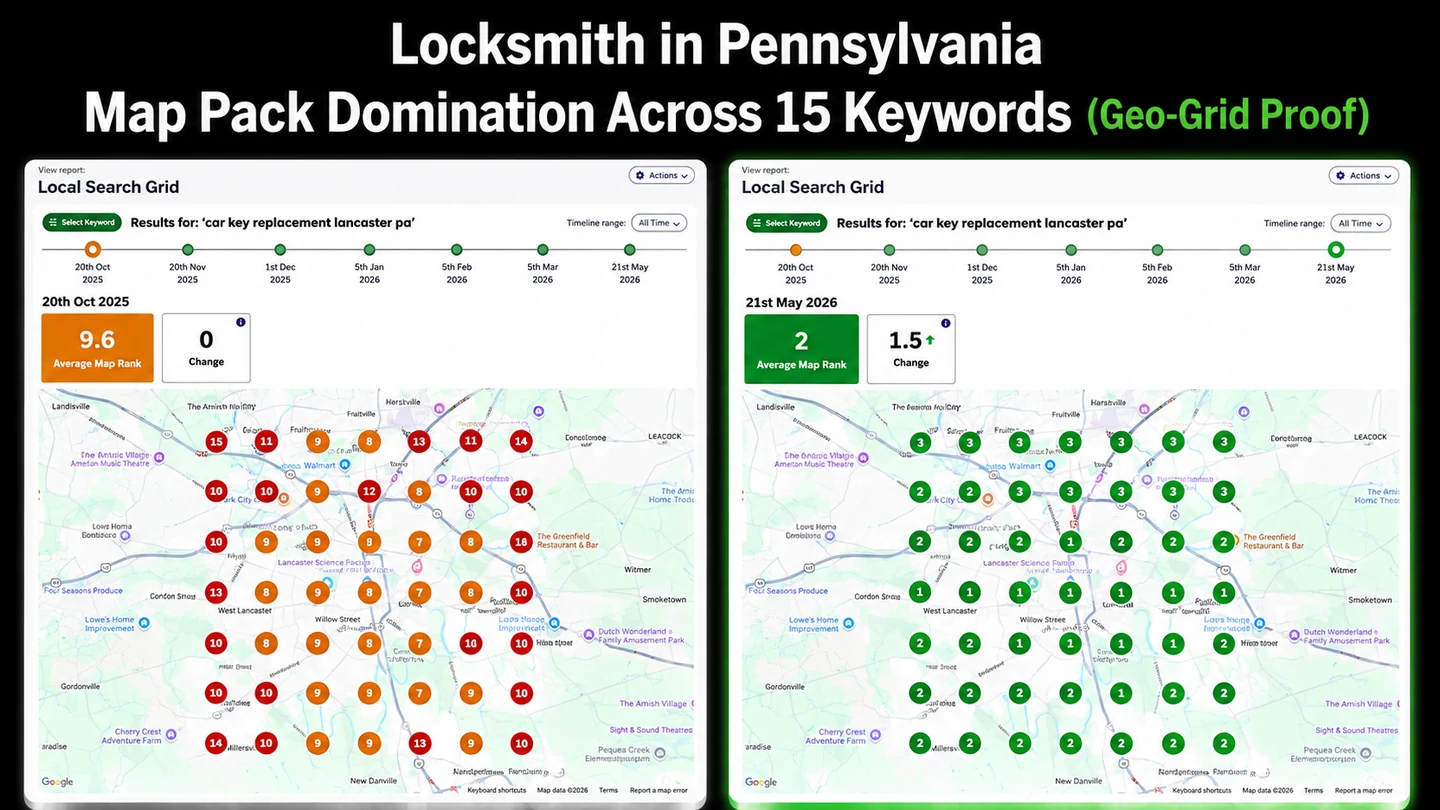
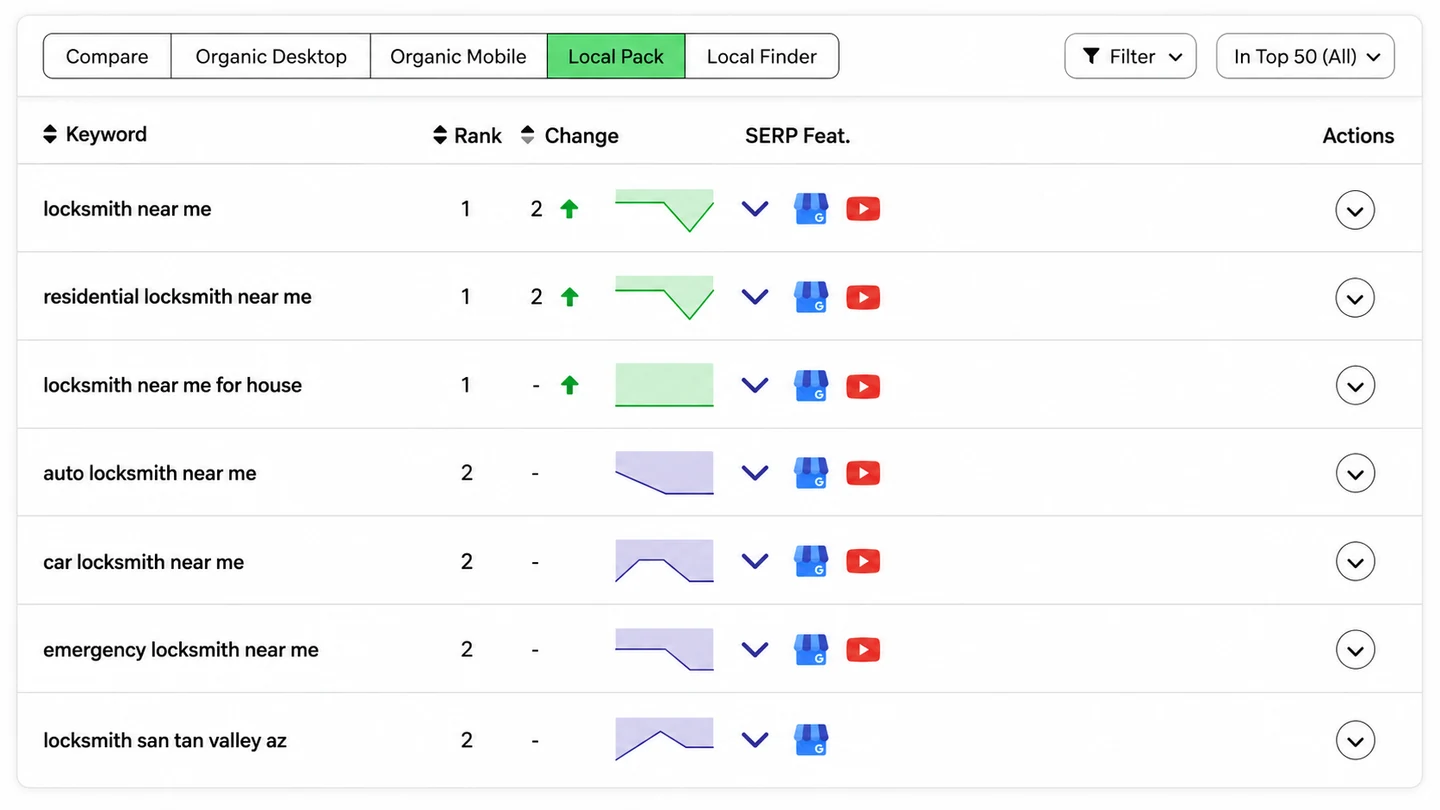
Read the grid, not just the average.
An average of 2.0 could hide a strong centre and weak edges. Here it does not — the outer points read 2 and 3 as well, which is what actually changes the volume of inbound calls.
Two more accounts, read exactly as reported
Both improved, for different reasons. Where a metric moved the wrong way it is still shown — that context is usually the most useful part of a report.
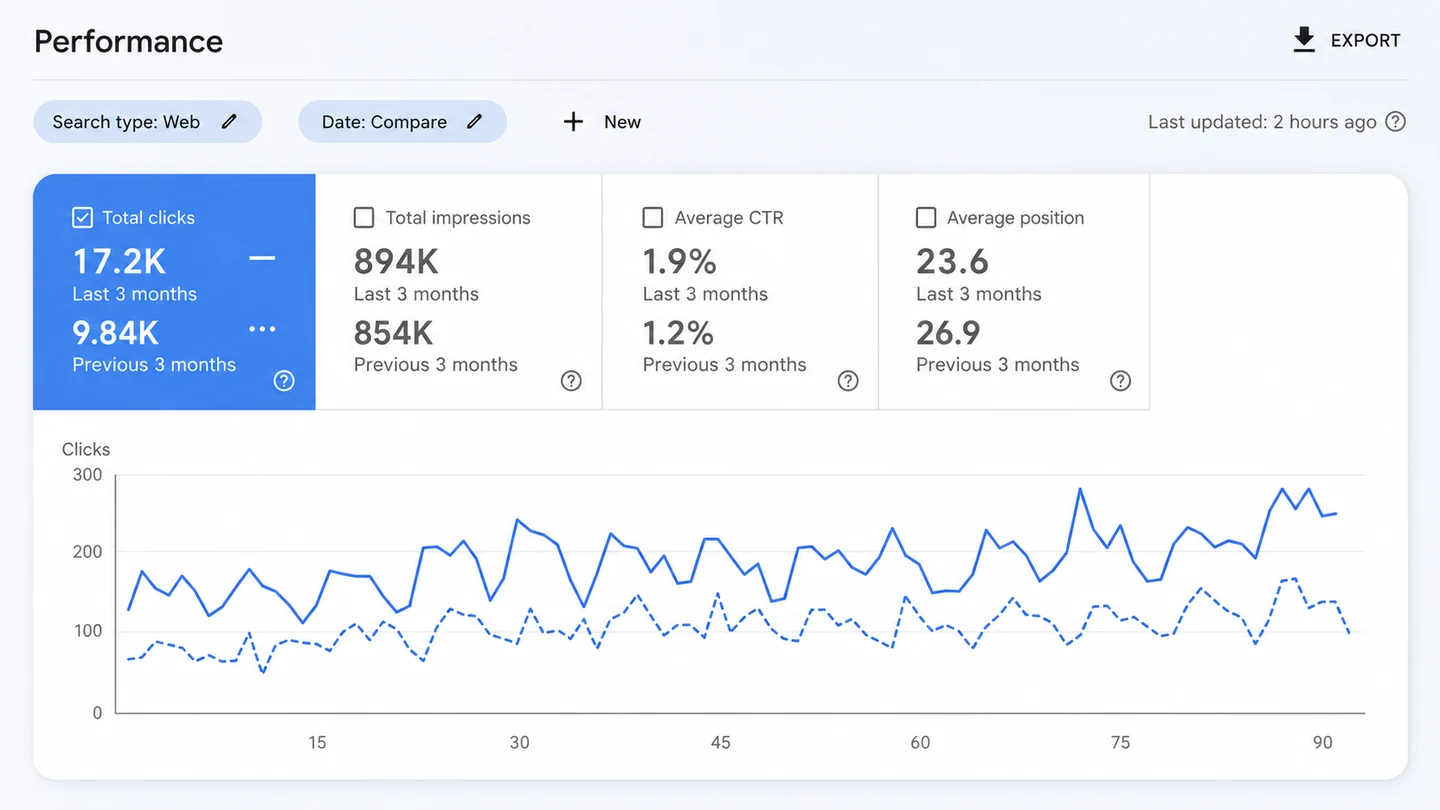
Clicks nearly doubled while impressions stayed almost flat
Impressions rose by about 5%, so the extra clicks did not come from new visibility. They came from better positioning and stronger titles on pages that were already being served.
The screenshot also shows average position improving from 26.9 to 23.6, and impressions of 894K against 854K.
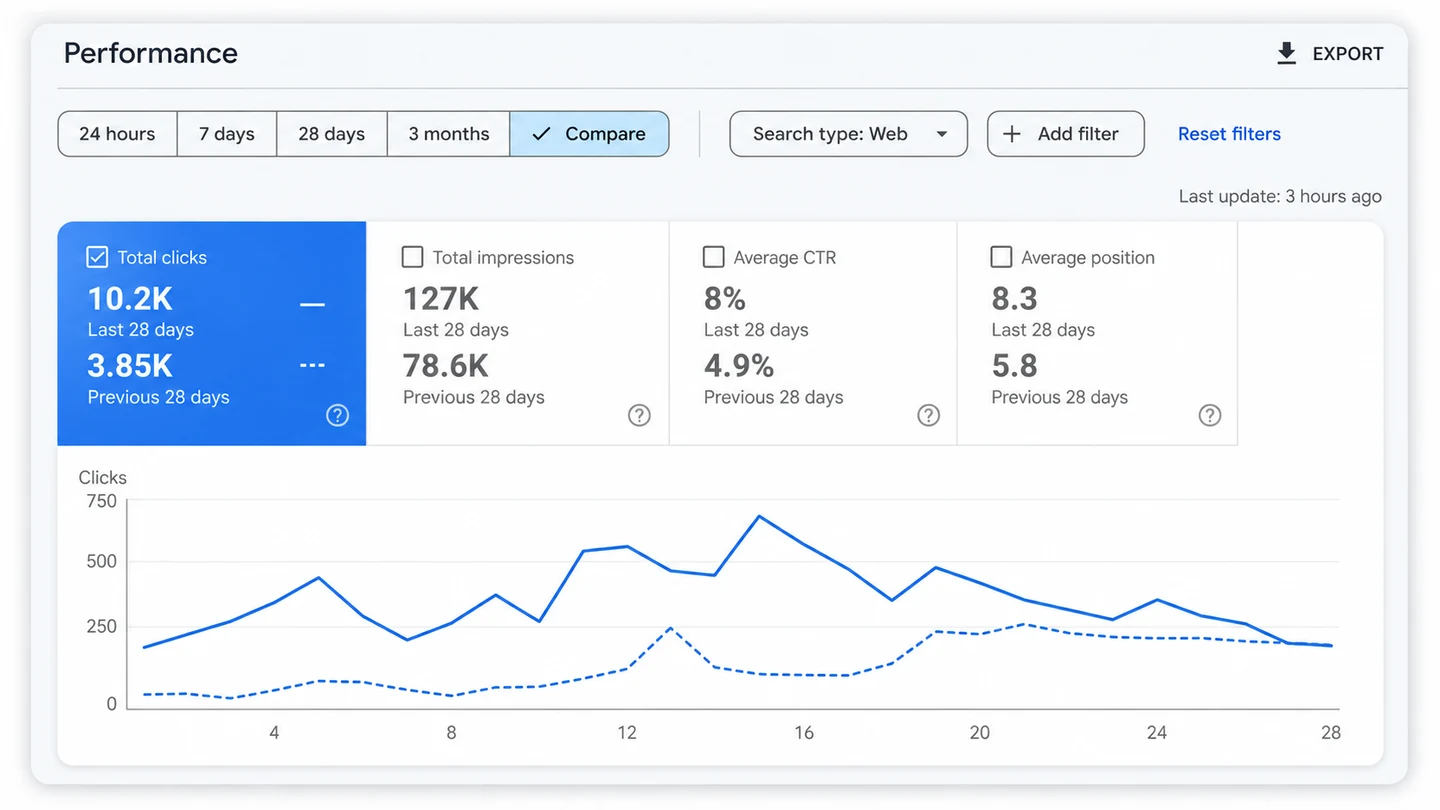
Wider coverage: more clicks, and a lower average position
Over 28 days, clicks went from 3.85K to 10.2K and impressions from 78.6K to 127K, with CTR rising from 4.9% to 8%.
The same screenshot shows average position moving from 5.8 to 8.3, which is a decline. That is expected here: the site started ranking for a much larger set of queries, and the newer ones entered lower down and pulled the average with them.
Three ways to work together
Every engagement starts with the same audit. Where it goes next depends on whether the constraint is the profile, the website, or the number of locations you are trying to hold visibility across.
Google Business Profile Optimization & Management
An audit and rebuild of the profile itself: categories, the full service list, business information, description, media and review handling — then ongoing management so the profile stays accurate as the business changes.
GBP optimization- Category and service structure
- Profile information and description
- Posts, media and review strategy
- Geo-grid rank tracking
Local SEO Management
Ongoing work across the whole local footprint: the website, the profile and the citations that connect them. Local keyword research, service and location page optimization, citation and NAP cleanup, technical fixes, and monthly reporting you can actually read.
Local SEO management- Local keyword research
- Service and location page SEO
- Citation building and NAP cleanup
- Search Console and rank reporting
Multi-Location Local SEO
For businesses running several profiles, branches or service areas. Consistent structure across every location, location pages that do not cannibalise each other, per-location tracking, and reporting that shows which markets are carrying the brand and which are lagging.
Multi-location SEO- Location-level profile structure
- Location page architecture
- Per-location rank tracking
- Agency and white-label support
Four steps, in this order, every time
The sequence matters more than the tactics. Optimizing a profile on top of broken foundations produces movement that does not hold.
-
01
Audit
Geo-grid scan of your current map visibility, a profile review against your top competitors, a citation and NAP check, and a pass over the website and Search Console. You get the findings whether or not we work together.
-
02
Fix the foundation
Correct the categories, complete the business information, resolve duplicate and inconsistent listings, and clear the technical issues stopping your service pages from being understood properly.
-
03
Optimize and build authority
Service and location pages rewritten around real local search demand, internal linking that connects them, citation building on sources that matter for your industry, and a review routine the business can sustain.
-
04
Track, refine and report
Monthly geo-grid scans and Search Console analysis, compared against the previous period. The report says what moved, what did not, and what changes next month — in plain language.

A specialist, not a marketing generalist
I have spent roughly 8,000 hours and more than 150 projects doing one narrow thing: making local businesses easier to find on Google. That total covers agency work, freelance engagements and direct client relationships across my career — not a single platform or a single year.
Local search rewards people who know where the levers are. Most of the work is unglamorous: a wrong primary category, a duplicate listing nobody claimed, a service page that never mentions the town it is meant to rank in. Finding those is the job.
- Local SEO and Google Business Profile specialist rather than a generalist
- Evidence-based reporting, including the numbers that moved the wrong way
- Agency, freelance and direct-client experience across the US market
- Organized communication and reliable remote collaboration across time zones
Top Rated Plus with 100% Job Success on Upwork, where a portion of my client work is contracted.
What agencies and business owners say
“Usman has been an exceptional asset to our team. Timely, organized, communicates clearly, and always goes above and beyond. His GBP optimization has made a significant impact across multiple clients. Highly recommend.”
“Very communicative throughout. Our website traffic is up over 200% since Usman optimized it. Will definitely hire again.”
“My go-to team member for SEO and Google Business work. Kind, appreciative, and hard-working.”
Answered before you ask
If something here is not covered, put it in the form and I will answer it directly rather than sending a brochure.
How long does Local SEO take?
Profile-level changes — categories, services, business information — can show movement within two to six weeks. Work that depends on citations, reviews and website authority generally takes three to six months to settle, and competitive metros take longer. The locksmith geo-grid on this site covers seven months between the two screenshots.
Do you guarantee #1 rankings?
No, and you should be wary of anyone who does. Nobody controls Google's ranking systems, and local results change by the searcher's location, device and query. What I commit to is the work, the diagnosis behind it, and honest reporting on what it produced.
What access will you need?
Manager access to your Google Business Profile, and access to Google Search Console and Google Analytics if they exist. For website work, either CMS access or a working relationship with whoever maintains the site. I do not need ownership of any account and I do not ask for passwords — delegated access is enough.
Do you work with service-area businesses?
Yes. Service-area businesses without a public storefront are a large part of my work — locksmiths, garage door companies, home services, mobile trades. They need a different approach from a storefront, since visibility has to be built across a radius rather than at a pin.
Do you work with multi-location companies?
Yes. Multi-location work is its own discipline: consistent structure across profiles, location pages that do not compete with each other, and per-location tracking so you can see which markets are performing. More on multi-location Local SEO.
Can you work with my existing website?
In almost all cases, yes. I work regularly on WordPress, Shopify, Wix, Squarespace, Webflow and custom builds. A rebuild is occasionally the right call, but it is a recommendation I make reluctantly and only when the current site is genuinely blocking progress.
Do you work with agencies?
Yes. A meaningful share of my work is white-label Local SEO and GBP delivery for agencies who want a specialist on local without hiring one full time. That can be unbranded reporting, direct client communication under your name, or purely back-end execution.
How are results reported?
Monthly. Geo-grid scans compared against the previous period, Local Pack rank tracking, Search Console performance, and a short written summary of what changed and why. If a metric moved the wrong way, it appears in the report with an explanation — as it does on this page.
Find out where you actually rank across your service area
Send me your business name, website and the towns you serve. I will run a geo-grid scan and a profile review, and reply by email with what I find — whether or not there is a project in it.